Introduction
Have you ever wondered why dissertation writing seems difficult? Many students struggle with planning and organising their research. A dissertation requires strong research skills and careful academic writing. It also requires patience, critical thinking, and proper time management. A successful dissertation starts with a clear research direction.
Students need to select an appropriate topic for their project. They must then develop suitable questions and research objectives. Reliable sources are also essential for building strong academic arguments. Dissertation writing services involve several connected stages and important decisions. Each chapter should support the main research purpose. Students should understand these stages before starting their writing. Proper preparation can make the entire process more manageable.
1. Choose a Strong and Relevant Dissertation Topic
Choosing a dissertation topic is the first major decision. Your topic should match your academic subject and interests. It should also provide enough material for detailed research. A focused topic makes the writing process much easier. Many students choose topics that are too broad. Broad topics can create problems during research and analysis. They may also produce too much unnecessary information. A narrow topic allows students to explore specific research issues. Before selecting your dissertation topic, consider several important factors. Think about available research sources and suitable data. You should also consider your deadline and available resources.
Ask yourself whether your topic is realistic and researchable. Consider whether you can find enough academic sources. Make sure your topic has clear research opportunities. A suitable topic creates a strong foundation for your dissertation. Your supervisor can also provide useful topic guidance. Discuss possible ideas before making your final decision. Their experience can help identify potential research problems. Early feedback can save significant time later.
2. Develop Clear Research Questions and Objectives
Research questions provide direction for the complete dissertation. They explain what your research intends to investigate. Strong questions should be clear and specific. They should also be possible to answer through research. Research objectives explain what your study aims to achieve. Each objective should connect directly with your research question. Avoid creating objectives that are unrelated to your main topic. A strong research question can improve your dissertation structure. It guides your literature review and research methodology. It also helps organise your findings and discussion.
For example, a business dissertation may explore customer satisfaction. The research could investigate factors affecting customer loyalty. The objectives could examine service quality and customer experience. Your questions should not be extremely simple or complicated. They should encourage analysis and critical thinking. Good research questions also help establish a clear academic argument. Spend enough time developing your questions and objectives. Changing them later can affect several dissertation chapters. Early planning can therefore prevent unnecessary rewriting.
3. Conduct a Detailed Literature Review
A literature review examines existing research related to your topic. It provides the academic foundation for your dissertation. Students should identify important theories and previous research findings. Reliable sources are essential for a strong literature review. Academic journals and books can provide valuable information. University publications and credible research databases are also useful.
Students should avoid simply listing previous studies. A strong literature review requires comparison and critical analysis. Explain how different researchers approach similar research problems. You should identify agreements and disagreements between researchers. Discuss important gaps within existing academic knowledge. These gaps can help establish the purpose of your research.
A useful literature review can answer several important questions:
- What research already exists?
- Which theories are important?
- What methods did previous researchers use?
- What disagreements exist within the literature?
- Which research gaps still require investigation?
Organising your sources by themes can improve readability. Avoid arranging sources only according to publication dates. Instead, connect studies through important ideas and research issues. Always record your sources during the research process. This approach makes referencing much easier later. It also reduces the risk of accidentally missing citations.
4. Select Suitable Research Methodology
Research methodology explains how your research will be conducted. Your chosen method should support your research questions. It should also provide reliable evidence for your conclusions. Qualitative research focuses on opinions and experiences. Interviews and observations are common qualitative research methods. These methods can provide detailed information about participants. Quantitative UK dissertation research focuses on numerical information. Surveys and statistical analysis are common quantitative approaches. They can help identify measurable patterns and relationships.
Some dissertations combine both approaches through mixed methods. This approach can provide different perspectives on a research problem. However, students should select methods based on research requirements. Your methodology chapter should explain your research design clearly. Describe how participants or data sources were selected. Explain your data collection process and analysis techniques. Ethical considerations are also important in many research projects. Participants should receive suitable information about the study. Personal information should be handled responsibly and securely.
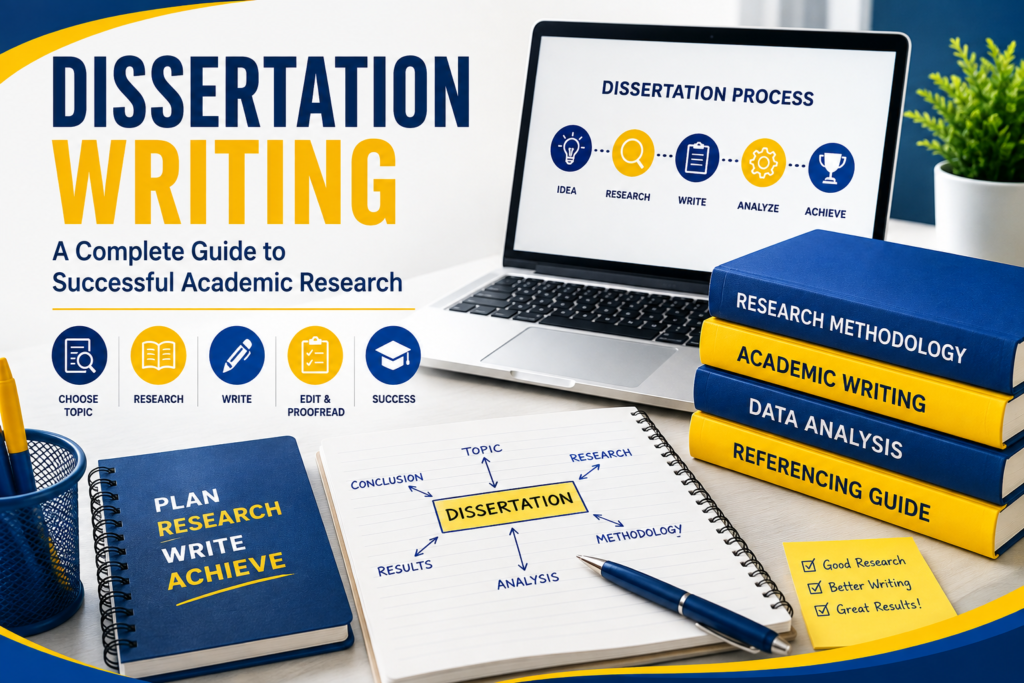
The following table summarises the major dissertation stages:
| Dissertation Stage | Main Purpose | Key Activity |
|---|---|---|
| Topic Selection | Define research area | Select focused subject |
| Research Questions | Set research direction | Develop clear questions |
| Literature Review | Examine existing research | Analyse academic sources |
| Methodology | Explain research process | Select suitable methods |
| Data Collection | Gather evidence | Conduct research |
| Findings | Present results | Analyse collected information |
| Discussion | Explain results | Compare research findings |
| Conclusion | Summarise research | Answer research questions |
| Proofreading | Improve final quality | Check errors and formatting |
5. Present Findings and Discussion Effectively
The findings chapter presents the results of your research. It should focus on evidence collected through your methodology. Avoid introducing information that was not part of your research. Tables and figures can make complex findings easier to understand. Use them when they provide meaningful value to readers. Each table should have a clear explanation within your text. The findings should connect with your research questions. Organise results around your research objectives when possible. This structure makes your research easier to follow.
The discussion chapter has a different purpose from findings. It explains what your research results actually mean. You should connect your findings with previous academic research. Compare your findings with studies discussed earlier. Explain whether your results support existing academic arguments. You should also discuss unexpected or different findings. Critical analysis is particularly important in this chapter. Do not simply repeat the information from your findings. Explain why certain results may have appeared. You can also discuss the practical meaning of your research. Explain how your findings may benefit organisations or researchers. However, all claims should remain connected with your evidence.
6. Edit, Reference and Proofread Your Dissertation
Editing dissertation writing is one of the most important final stages. A strong first draft can still contain several weaknesses. Careful editing can improve clarity and academic presentation. Begin by reviewing the overall dissertation structure. Make sure every chapter supports your research objectives. Check whether your arguments develop logically throughout the document. Then review individual paragraphs and sentences. Remove unnecessary repetition and unclear statements. Make sure your academic language remains consistent. Referencing is another essential part of dissertation writing. Students must acknowledge information taken from other researchers. Follow the referencing style required by your university. Common referencing styles include Harvard and APA. Other universities may require MLA or Chicago referencing. Always follow your specific institutional guidelines.
Check that every citation appears correctly in your reference list. Also check that every listed source is cited. Consistent referencing improves academic credibility. Proofreading should happen after the main editing process. Look for grammar and spelling errors during this stage. Check headings, page numbers, tables, figures, and formatting. It can also help to read your dissertation aloud. This method can reveal awkward sentences and unclear transitions. Another person can provide useful feedback before submission. Finally, compare your completed dissertation with university requirements. Check word count and formatting rules carefully. Confirm that all required sections are included.
Conclusion
Dissertation writing requires careful planning and consistent academic effort. Students should begin by selecting a focused research topic. Clear research questions and objectives should follow this decision. A detailed literature review provides a strong academic foundation. Suitable research methodology supports reliable evidence and analysis. Findings should be presented clearly and discussed critically. The final dissertation should have logical connections between all chapters. Proper referencing protects academic integrity and improves credibility. Careful editing and proofreading also improve the final presentation.
Students who follow a structured approach can reduce writing difficulties. Good time management can also prevent unnecessary deadline pressure. Most importantly, every section should support the main research purpose. With proper preparation and consistent effort, dissertation writing help becomes manageable. A clear structure can help students produce professional academic research. Strong research and careful writing can also improve overall dissertation quality.