Introduction
Dissertation writing is an important part of higher education. Students must complete extensive research before presenting their final work. A dissertation requires careful planning and strong organisational skills. It also requires critical thinking and effective academic communication. Many students find this process challenging because it involves several research stages. A clear plan can make the entire process more manageable. This Dissertation Writing Guide explains the major stages of dissertation development. It provides useful information for students and researchers seeking better research outcomes.
Dissertation Help for Students
Many students need Dissertation Help when beginning their research project. A dissertation can involve hundreds of hours of research and writing. Students may struggle with selecting topics or developing research questions. Others may find research methods and data analysis difficult. Understanding the university requirements is also extremely important. Students should carefully review their institution’s dissertation guidelines before starting. Reliable Dissertation Support can help students understand difficult stages. However, students should remain involved in developing and understanding their research.
Dissertation Writing Services
Dissertation Writing Services can provide professional assistance during different stages. Students may receive support with planning, research, writing, editing, or proofreading. Such services can be useful when students face demanding deadlines. They can also help improve structure and academic presentation. Students should always choose services that provide original and well-researched content. The quality of sources should also be considered carefully. Any external assistance should follow university academic integrity requirements. Professional guidance should support learning rather than replace genuine academic work.
Dissertation Research
Dissertation Research forms the foundation of every successful dissertation. Researchers must investigate their selected subject using reliable academic sources. The research should address a specific problem or unanswered question. Students should begin by reviewing existing studies in their chosen field. This process helps identify important debates and research gaps. Researchers can then develop a clear direction for their own study. Reliable research also makes the final arguments more convincing. Good research requires patience, careful evaluation, and consistent documentation.
Dissertation Structure
A clear Dissertation Structure helps readers understand the research easily. Most dissertations contain several major chapters with different purposes. These often include an introduction, literature review, methodology, results, discussion, and conclusion. Some universities may require additional sections or different chapter arrangements. Students should always follow their institution’s specific requirements. Every chapter should connect with the main research question. Strong transitions can also improve the flow between different sections. A logical structure makes complex research easier to communicate.
Dissertation Methodology
Dissertation Methodology explains how the research will be conducted. Researchers must select methods that match their research questions and objectives. Qualitative research may focus on experiences, opinions, and detailed responses. Quantitative research normally focuses on numerical data and measurable relationships. Some projects combine both approaches through mixed-method research. Students should explain why their chosen method is appropriate. They should also describe their participants, data collection procedures, and ethical considerations. A well-explained methodology improves the credibility of the research.
Dissertation Topic Selection
Dissertation Topic Selection is an important early stage. Students should choose a topic that interests them and fits their subject. The topic should also have enough reliable research material available. Very broad topics can make research difficult to control. Very narrow topics may provide limited opportunities for investigation. Students should consider current academic discussions when selecting their topic. They should also identify possible research gaps within the selected area. A focused topic provides a stronger foundation for successful research.
Dissertation Literature Review
A Dissertation Literature Review examines existing studies related to the research topic. It demonstrates the researcher’s understanding of previous academic work. Students should not simply list information from different sources. Instead, they should compare studies and evaluate their findings critically. Researchers should identify important similarities and differences between existing studies. They should also discuss limitations within previous research. Identifying research gaps helps explain why the new study is necessary. A strong literature review creates an important foundation for the dissertation.
Dissertation Data Analysis
Dissertation Data Analysis involves examining collected information to identify meaningful findings. The appropriate analysis method depends on the research design. Quantitative studies may use statistical techniques to evaluate numerical information. Qualitative studies may examine themes, opinions, and recurring patterns. Researchers should explain their analytical process clearly. Tables and figures can help present important results effectively. However, researchers should also explain what the findings actually mean. Clear analysis connects collected data with the research questions and objectives.
Dissertation Editing
Dissertation Editing improves the clarity and overall quality of academic writing. Students should edit their work after completing the initial draft. Editing involves reviewing sentence structure, organisation, academic tone, and logical flow. Researchers should remove unnecessary repetition and unclear explanations. Each paragraph should contribute something meaningful to the discussion. Students should also check whether arguments are supported by suitable evidence. Careful editing can make complicated ideas easier for readers to understand. It can also improve the professional presentation of the dissertation.
Dissertation Proofreading
Dissertation Proofreading is the final quality-checking stage. It focuses on identifying smaller errors that may remain after editing. Students should check spelling, grammar, punctuation, and formatting carefully. References and citations should also be checked for consistency. Tables, figures, headings, and page numbers require attention as well. Reading the dissertation several times can reveal overlooked mistakes. Students can also use professional proofreading support when appropriate. A carefully proofread dissertation creates a stronger final impression.
Academic Research
Academic Research requires reliable sources and careful evaluation of information. Researchers should use credible journals, books, reports, and other scholarly materials. Every source should contribute meaningfully to the research discussion. Students should avoid relying heavily on unreliable websites or unsupported claims. Academic research also requires accurate citations and responsible information handling. Researchers should understand the difference between evidence and personal opinion. Strong research practices improve both credibility and academic value. They also help students develop stronger arguments.
Research Methodology
Research Methodology provides a detailed explanation of the research approach. It describes how information will be collected and analysed. Researchers should explain why specific methods were selected. They should also discuss possible limitations within their chosen approach. Ethical issues should be addressed when research involves participants. A well-developed methodology allows readers to understand how findings were produced. It also helps other researchers evaluate the reliability of the research process. Clear methodology is therefore essential for a strong dissertation.
Dissertation Research Methods
Dissertation Research Methods vary according to the research question. Surveys can collect information from larger groups of participants. Interviews can provide detailed information about individual experiences. Case studies can examine specific situations in greater depth. Experiments can investigate relationships between controlled variables. Researchers may also use secondary data from reliable existing sources. The selected method should always support the research objectives. Students should explain their choice clearly within the methodology chapter.
Dissertation Writing: Key Stages at a Glance
| Dissertation Stage | What You Need to Do | Key Focus |
|---|---|---|
| Topic Selection | Choose a focused and relevant research topic. | Relevance and research scope |
| Research Question | Develop a clear question for investigation. | Focus and direction |
| Literature Review | Examine existing academic studies and research gaps. | Critical analysis |
| Research Methodology | Select suitable research methods and explain them. | Validity and reliability |
| Data Collection | Gather relevant information from reliable sources. | Accuracy and ethics |
| Data Analysis | Examine data and identify important findings. | Patterns and evidence |
| Dissertation Structure | Organise chapters in a logical sequence. | Clarity and organisation |
| Discussion | Explain findings and compare them with previous research. | Critical thinking |
| Dissertation Editing | Improve grammar, flow, structure, and academic style. | Quality and readability |
Dissertation Writing Tips
Following practical Dissertation Writing Tips can improve the writing process. Students should create a realistic research schedule before beginning. Breaking large tasks into smaller activities can reduce pressure. Researchers should maintain organised notes throughout the research process. They should also save references while reading academic sources. Writing regularly can prevent large amounts of work accumulating near deadlines. Students should review university guidelines throughout the project. Regular feedback from supervisors can also help improve the dissertation.
How to Write a Dissertation
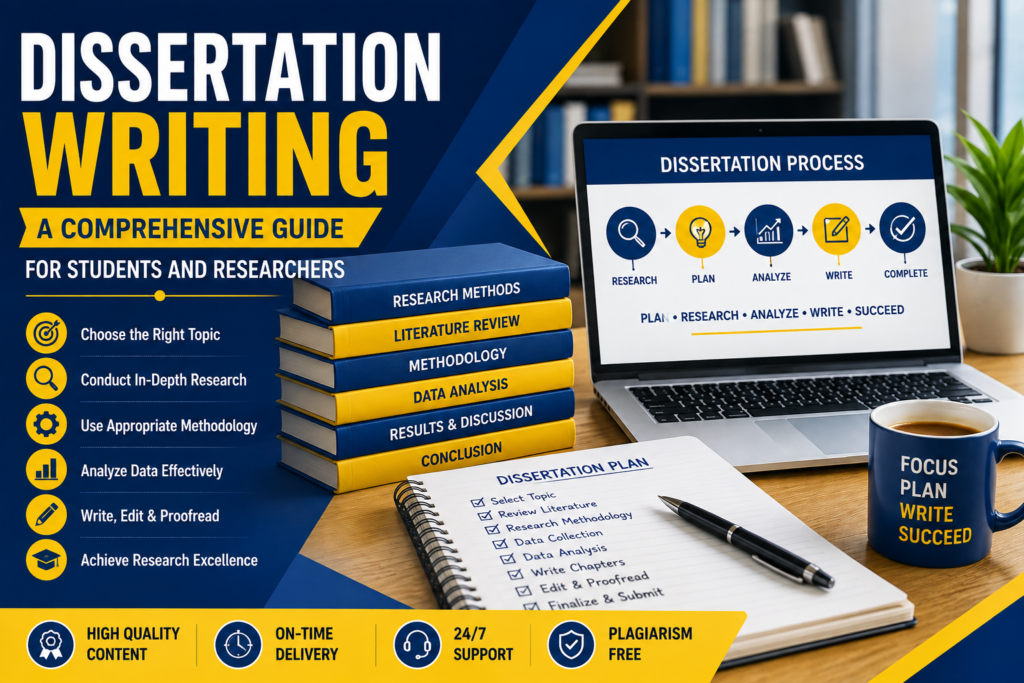
Understanding how to write a Dissertation requires knowledge of the complete research process. First, students should select a focused and relevant topic. They should then develop clear research questions and objectives. The next stage usually involves reviewing existing academic literature. After that, researchers select suitable methods for collecting information. Data is then analysed before findings are discussed in relation to existing research. The final stage involves writing conclusions and reviewing the complete dissertation. Following these steps creates a more organised research journey.
Dissertation Support
Dissertation Support can help students manage challenging research stages. Supervisors can provide guidance about research questions and methodology. University writing centres may also provide useful academic resources. Students can use libraries and research databases to find reliable sources. Peer feedback can provide another useful perspective during the writing process. Professional services may offer additional editing or proofreading assistance. Students should select support that follows their university’s academic policies. The main goal should always be developing stronger research and writing skills.
Research Dissertation
A Research Dissertation presents the complete findings of an extended research project. It should demonstrate knowledge of the chosen subject and existing literature. It should also present a clear research argument supported by evidence. Researchers must explain their methods and discuss their findings carefully. The discussion should connect new findings with previous academic research. Limitations should also be acknowledged honestly. A strong dissertation provides useful insights into the selected research problem. It may also identify opportunities for future research.
Successful Dissertation Writing
Successful Dissertation Writing depends on preparation and consistent effort. Students should avoid leaving major tasks until the final weeks. Creating deadlines for individual chapters can make progress easier. Regular writing also helps maintain consistency throughout the dissertation. Researchers should continuously compare their work with the research objectives. They should check whether each chapter contributes to the main argument. Feedback should be considered carefully before making final improvements. Consistent planning can significantly improve the overall writing experience.
Dissertation Guide for Students
A Dissertation Guide for Students should provide practical information about every research stage. Students need to understand their university requirements before starting. They should also develop a realistic research plan and timeline. Choosing suitable sources is essential for developing strong academic arguments. Researchers should maintain clear notes to avoid confusion later. Each chapter should be reviewed before moving to the next stage. Final editing and proofreading should never be ignored. With organised preparation, students can approach dissertation writing with greater confidence.
Conclusion
Dissertation writing services are a detailed process that requires planning and commitment. Students must carefully select their topics and develop clear research questions. Literature reviews help establish existing knowledge and identify research gaps. Methodology explains how the research will be conducted and evaluated. Data analysis then transforms collected information into meaningful research findings. Editing and proofreading improve clarity, accuracy, and academic presentation. Students can also use appropriate support when facing difficult research stages. By following a structured approach, researchers can produce well-organised and valuable dissertations.